
By Oscar Whittaker September 15, 2026
Gas station cash credit pricing looks simple until the station has to make the roadside sign, dispenser, petroleum POS, payment tender, loyalty engine, and receipt agree with one another.
A station can offer different cash and card fuel prices only when the pricing structure, advertising, dispenser display, and transaction configuration comply with the rules that apply at that location.
The first question is not, “How many cents should we add for cards?” It is, “What pricing model are we actually operating?”
Dual pricing, a cash discount, and a credit-card surcharge can produce similar-looking economics while creating different payment-network, advertising, receipt, and operational questions. Fuel adds another layer because the advertised price is often what convinces a motorist to pull into the station before the customer reaches the point of sale.
A processor’s approval of a payment program does not answer whether the station’s fuel-price sign complies with weights-and-measures or motor-fuel advertising law. Conversely, a compliant roadside sign does not guarantee that the dispenser will select the correct price when a customer inserts a debit card.
The goal is straightforward: the customer should be able to understand the applicable fuel price before dispensing, and the station should charge exactly the price its system says applies to that transaction.
Gas Station Cash Credit Pricing: Dual Pricing, Cash Discount, or Surcharge?
Before fabricating signs or changing dispenser programming, define the pricing structure.
That distinction controls almost everything that follows.
| Model | Customer Sees | Card Treatment | Core Legal/Operational Question |
| Dual pricing | Separate cash and card prices | Different selling price applies by tender | How must each price and qualifier be advertised? |
| Cash discount | Base/posting structure with a reduction for qualifying cash payment | Discount is triggered by qualifying tender | How must the base price, discount, and conditions be disclosed? |
| Surcharge | Normal price plus an additional charge for eligible credit-card use | Additional card charge | Are network, state, disclosure, and receipt rules satisfied? |
Dual pricing
Under dual pricing, the station establishes two actual fuel prices, such as:
- Cash: $3.499 per gallon
- Credit: $3.599 per gallon
The important concept is that the customer is choosing between separately disclosed selling prices based on the applicable payment condition.
For gas station cash credit pricing, that distinction matters because the roadway sign, dispenser, and petroleum POS need to recognize the same two-price structure.
Cash discount
A cash discount is structured around a stated or base price from which a qualifying cash customer receives a reduction.
Depending on the jurisdiction, describing a program as a “discount” may affect the required advertising treatment. California, for example, contains specific motor-fuel advertising provisions addressing price reductions and the conditions attached to them.
The accounting economics may look similar to a two-price model, but operators should not assume the signage analysis is identical.
Surcharge
A surcharge is different again. Instead of creating two fuel prices, a surcharge adds an amount to an otherwise applicable price when an eligible credit card is used.
Card-network rules become particularly important here. Visa’s current U.S. guidance distinguishes surcharging from ordinary pricing and imposes conditions on eligible credit-card surcharges; debit treatment is not something a station should improvise at the POS.
A network-compliant surcharge does not automatically make a fuel-price advertisement compliant with state law.
Before setting a cash-credit spread, separate the signage decision from the economics of fuel-station processing costs and transaction pricing. Processing expense may influence pricing strategy, but it does not determine what a state allows a station to advertise on the roadside sign.
Why Fuel Pricing Is Different From Ordinary Retail

A restaurant customer normally sees a menu after entering the business. A fuel customer may make the buying decision while traveling at road speed.
The street sign is therefore not decorative. It can be a regulated price advertisement.
The motorist may encounter several pricing layers in less than two minutes:
- Roadside or marquee price.
- Cash/credit qualifier.
- Grade price at the dispenser.
- Payment-method selection.
- Loyalty prompt.
- Final per-gallon price.
- Transaction total.
- Receipt.
That creates a problem ordinary retail does not face as frequently: the advertised unit price, the dispenser’s unit price, and the POS’s transaction logic can diverge.
Consider a station advertising regular gasoline at $3.499 cash and $3.599 credit.
If the roadside sign says $3.499 CASH but the pump selects $3.599 for a qualifying cash transaction, the issue is not merely an unhappy customer. The station has advertised one price and delivered another.
If the dispenser applies $3.499 to a debit transaction but the POS later adds a fee that effectively changes the amount, another mismatch has been created.
If loyalty subtracts five cents from an already discounted tier when the promotion was intended to apply only to the credit tier, the station has a configuration problem even when every individual component appears to be functioning.
This is why good gas station cash credit pricing starts with a price architecture, not a sign order.
Dual Pricing Fuel Signage Rules: What the Street Sign Must Show
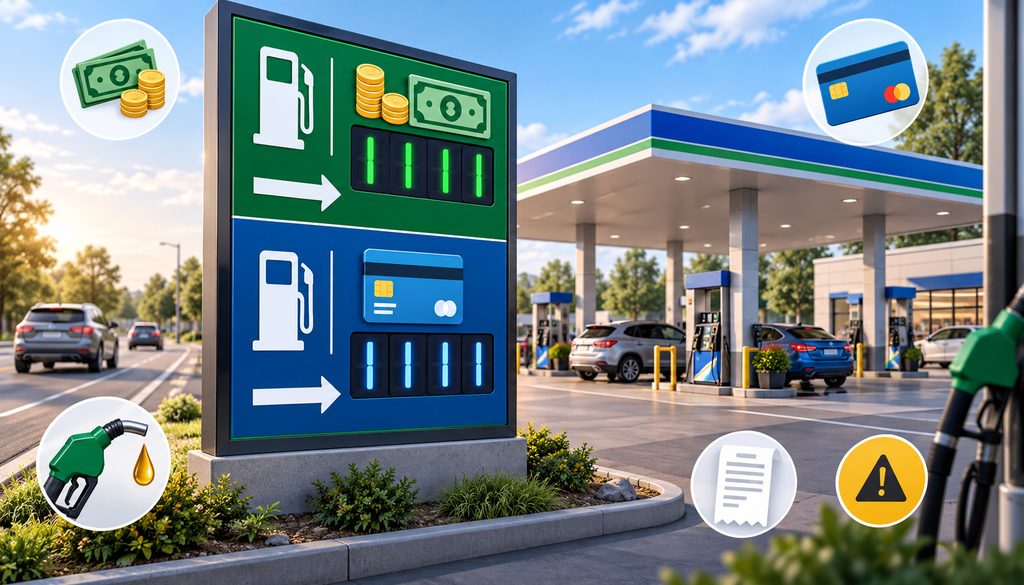
There is no single national street-sign template that a fuel retailer can copy for every location.
Dual pricing fuel signage rules depend heavily on state motor-fuel advertising statutes, weights-and-measures rules, consumer-protection requirements, and sometimes local sign ordinances.
The questions a station needs answered include:
- May only the lower cash price appear?
- If multiple prices exist, must each price appear?
- Must higher prices receive equal prominence?
- How close must the payment qualifier be to the price?
- Are minimum lettering dimensions specified?
- Must the condition say “cash,” “credit,” “credit/debit,” or something else?
- Can loyalty pricing appear on the primary sign?
- Does the rule change when the same dispenser sells at more than one price?
Those questions cannot be answered by looking at a neighboring station.
Representative state differences: California and Massachusetts
California provides a useful example of why a station cannot assume that advertising only the lowest price with a small qualifier is acceptable.
Under the state’s motor-fuel advertising provisions, when the same grade is sold at different prices, the applicable higher prices must also be advertised under the conditions specified by California law, including equal-size price numerals in the circumstances covered by the statute.
California illustrates why prominence cannot be treated as a design preference. When multiple prices for the same grade are offered, the state’s fuel-price advertising law requires the higher applicable prices to be advertised under specified conditions, including equal-size price numerals in the circumstances covered by the statute.
Massachusetts takes a different regulatory approach. Its motor-fuel advertising standards state that when cash sales and other types of sales are made from the same dispenser, both prices must be posted and clearly identified for the applicable type of sale. The regulation also contains its own sign-format and visibility requirements.
The operational lesson is not “use California’s format” or “use Massachusetts’ format.”
It is that state fuel price advertising laws can dictate the architecture of the sign itself.
| State | Both Prices Required? | Prominence/Qualification Point | Pump/Dispenser Point | Last Verified |
| California | When advertising a grade sold at multiple prices, applicable higher prices must also be advertised under the cited rule | Higher prices use equal-size numerals; conditions/limitations must be explained | State guidance specifically connects permissible advertising to dispenser multiple-price capability | September 2026 |
| Massachusetts | Both prices must be posted when cash and other sales are made from the same dispenser | Prices must be clearly labeled by sale type; regulation includes specific visibility/format provisions | Same-dispenser multiple-price presentation is expressly addressed | September 2026 |
A multi-site operator should maintain a jurisdiction-specific rule matrix rather than copy one state’s sign format into another market. For example, California’s motor-fuel advertising requirements and Massachusetts’ motor-fuel pricing standards regulate multiple-price presentation differently, which is enough to make a one-template national rollout risky.
Cash Price Street Sign Requirements and Price Prominence
Cash price street sign requirements should be resolved before a sign company begins fabrication or a digital marquee template is deployed.
For each jurisdiction, obtain answers to these questions:
| Sign Element | What to Verify | Common Risk |
| Cash price | Whether it may appear alone | Advertising only the attractive lower number when another price must also appear |
| Credit price | Whether it must also be displayed | Higher price hidden until the customer reaches the pump |
| Qualifier | Required wording and placement | “Cash” or another condition is too remote from the price |
| Relative prominence | Whether price numerals must be equal or otherwise constrained | Lower price dominates the sign deceptively |
| Loyalty price | Whether conditional member pricing may be advertised and how | Motorist believes loyalty-only price is generally available |
| Fractional cent | Applicable display convention | Sign and dispenser use different unit-price presentation |
| Visibility | State/local readability requirements | Technically present qualifier cannot reasonably be seen |
| Local zoning | Physical sign dimensions, illumination, placement | Price content is legal but sign installation violates local ordinance |
The phrase cash price street sign requirements therefore refers to more than whether the word “cash” appears somewhere on the property.
The regulator may care about what an ordinary motorist understands from the complete display.
Never let the qualifier become fine print
A dangerous design is a giant $3.29 price with a tiny CASH ONLY qualifier that is effectively invisible from the road.
Even without assuming a particular state’s dimensional rule, this creates an obvious misleading-advertising concern.
A qualifying condition is useful only when the customer can associate it with the advertised price.
California illustrates the point with explicit relative-size rules for certain fuel-price advertising conditions. Massachusetts has its own detailed sign requirements. Those rules should be checked directly rather than replaced with an operator’s subjective opinion about what is “readable.”
Street-sign price hierarchy
Three conceptual structures illustrate why the legal review comes first.
Model A
Cash $X.XX
Credit $Y.YY
This is classic dual-price presentation.
Model B
Regular $Y.YY
Cash discount $X.XX
This emphasizes a base price and conditional reduction.
Model C
Cash $X.XX
Credit $Y.YY
Member Cash $Z.ZZ
Now the operator is advertising a third condition tied to loyalty status.
None of these formats should be treated as universally legal. The permitted hierarchy and prominence depend on applicable law.
That is the core lesson behind dual pricing fuel signage rules: determine what the jurisdiction requires, then design the sign.
Pump Price Display Cash vs Credit: What the Customer Must See at the Dispenser
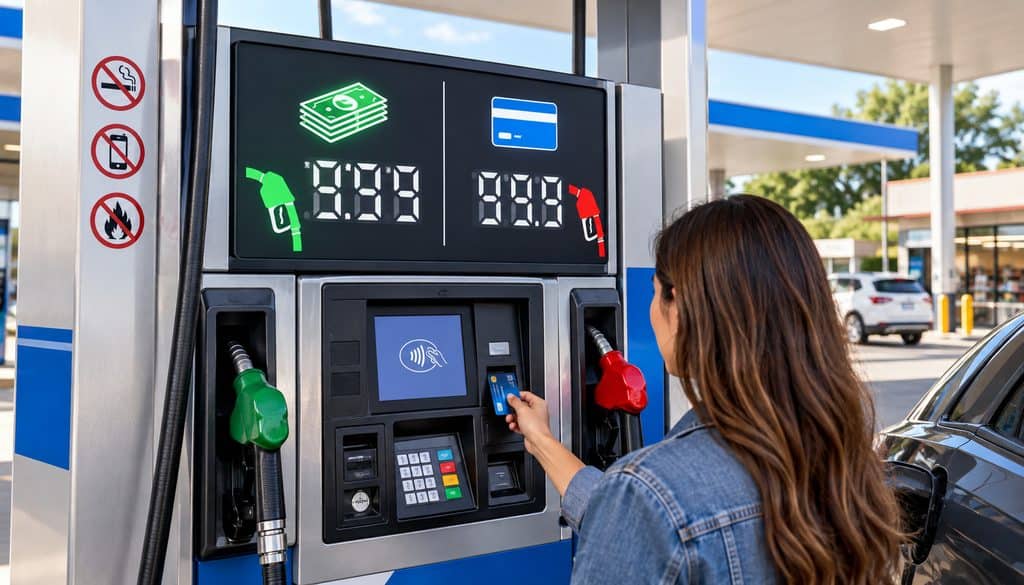
The roadside sign gets the driver onto the property. The dispenser determines whether the promised price is actually deliverable.
A useful pump price display cash vs credit test follows the customer’s path:
Street sign → dispenser → payment selection → applicable price tier → gallons delivered → total → receipt.
Every step should reinforce the same pricing condition.
If a station is genuinely selling regular gasoline at one price for cash and another for cards, the dispenser must be capable of applying the appropriate price before or during delivery according to the system design and applicable rules.
California’s fuel-price guidance specifically notes that dispenser functionality limits what multiple-price arrangements can be offered and advertised. Its guidance states that equipment capable of multiple prices must allow the customer to make the necessary price selection in the situations covered by the state’s adopted requirements.
What should be tested at the pump?
Depending on the jurisdiction and system, the station should verify:
- grade;
- unit price;
- cash/card condition;
- loyalty condition;
- payment selection;
- total gallons;
- sale amount;
- final price tier;
- receipt.
Do not assume the pump is correct merely because the marquee is correct.
A technician can update the central price table while one dispenser remains offline and retains an older tier. A premium grade can be missed. Cash can update while credit remains stale.
That is why pump price display cash vs credit testing must be done physically at the island.
What happens when the pump and street sign disagree?
Suppose the street sign shows:
Cash regular: $3.399
Credit regular: $3.499
Pump 7 displays $3.499 after the customer prepays cash.
That should be treated as a pricing exception immediately.
The station should capture:
- pump number;
- grade;
- payment method;
- advertised price;
- dispenser price;
- receipt;
- transaction time;
- loyalty status;
- any manual intervention.
Possible consequences include customer refund requests, complaints to regulators, reconciliation differences, and allegations that the displayed price was misleading.
Arguing with the motorist does not fix the underlying price file.
Receipt requirements and receipt design
Receipt rules vary, so an operator should verify what applicable state law and the payment system require.
Operationally, however, a useful fuel receipt should make it possible to reconstruct the transaction. Relevant fields may include gallons, grade, per-gallon price, total, discounts, and payment information according to the system’s capabilities and legal requirements.
If a separate discount is shown, it should reconcile mathematically to the actual fuel price.
A station testing gas station cash credit pricing should never examine only the authorization amount. The receipt is the last customer-facing representation of what happened.
Visa also maintains receipt requirements for card transactions, subject to exceptions and transaction conditions, which is another reason that “the pump printed something” is not a complete compliance test.
Older dispenser hardware can limit how tender-specific prices, prompts, and loyalty selections are presented, so pay-at-the-pump EMV and contactless upgrade considerations should be reviewed before assuming an existing pump can support the planned two-price workflow.
State Fuel Price Advertising Laws and Weights-and-Measures Rules
State fuel price advertising laws should be treated as a separate compliance layer from payment-network rules.
A fuel retailer may need to consider four different authorities:
- Motor-fuel advertising statutes or regulations.
- Weights-and-measures requirements.
- General consumer-protection/deceptive-advertising law.
- Municipal sign and zoning ordinances.
The first three address what the station represents and charges. The fourth may govern where and how the physical structure can be installed.
Weights-and-measures enforcement is not just about gallon accuracy
Station operators sometimes think of weights and measures solely as “Does five gallons dispensed equal five gallons measured?”
Price accuracy is also part of the regulatory environment.
California’s Division of Measurement Standards says its petroleum responsibilities include enforcing advertising and labeling standards in addition to commercial measurement accuracy. Massachusetts similarly places retail pricing and fuel measuring devices within the responsibilities of its standards program.
For gas station cash credit pricing, that means a forecourt can be mechanically accurate while still presenting a price-advertising problem.
A dispenser can deliver exactly 10.000 gallons and still charge the wrong tender-specific unit price.
Higher price versus lower price advertising
This is an area where operators should avoid national generalizations.
California specifically prohibits certain lower-price-only advertising when the same grade is sold at multiple prices and requires the relevant higher prices to appear under its rules.
Massachusetts instead expresses its own requirement concerning both prices when cash and other sales are made from the same dispenser.
Another state may frame the issue differently.
Therefore, state fuel price advertising laws should be documented by jurisdiction and effective date.
A multi-state petroleum retailer should never send a national marketing department a single sign template with instructions to “use everywhere.”
Local ordinances are a separate check
The state may dictate the fuel-price information while a city or county regulates:
- monument-sign dimensions;
- setback;
- illumination;
- electronic message signs;
- brightness;
- permitting;
- placement.
Passing the local zoning review does not mean the cash/credit price content is compliant.
Likewise, a legally formatted price message does not authorize an otherwise prohibited sign installation.
A clean compliance file distinguishes those two reviews.
Configuring Cash and Credit Price Tiers Across POS and Dispensers
Once the signage model is settled, the operational risk shifts into the pricing stack.
A typical station may have some combination of:
- back-office pricing;
- petroleum POS;
- forecourt controller;
- dispenser electronics;
- digital street sign controller;
- loyalty engine;
- payment host;
- fleet interface.
The precise architecture varies by equipment and vendor.
A properly configured integrated pump and in-store payment system can reduce the number of manual price changes between the register and forecourt, but each site still needs to verify that cash, credit, debit, and loyalty tiers are actually supported by its specific POS, controller, and dispenser combination.
Build the price-tier map first
Before changing live prices, document the intended behavior.
Potential tiers include:
- CASH
- CREDIT
- DEBIT
- LOYALTY CASH
- LOYALTY CREDIT
- FLEET
- PROMOTIONAL
Those names are examples, not a claim that every platform supports each tier.
The requirement is deterministic logic.
Given a particular grade, tender, loyalty state, and promotion, the system should have one intended answer.
| Tender | Base Tier | Loyalty Effect | Potential Conflict |
| Cash | Cash | Apply only if program permits | Discount may stack twice |
| Credit | Credit | Defined credit/member reduction | Loyalty may calculate from wrong base |
| Debit | Explicitly defined | Program-specific | System may incorrectly treat debit as credit |
| PIN debit | Explicitly defined | Program-specific | Routing behavior may differ from pricing assumption |
| Fleet | Contract/program-specific | Often separately defined | Consumer credit tier may be inappropriate |
| Mobile wallet | Underlying tender/configuration matters | May identify member automatically | Wallet does not necessarily identify price tier by itself |
Debit requires its own decision
Do not hide debit inside the word “card.”
A station needs a documented answer to:
Which fuel price applies to a debit card, and why?
In a surcharge structure, credit-card surcharge rules cannot simply be applied to debit.
Debit should be defined before the sign and POS are programmed. California’s multiple-price fuel guidance shows why: the terminology used for cash and credit pricing can affect how debit-card transactions fit the advertised price structure.
That is a significant operational detail.
The cashier should not be making a spontaneous decision about whether a customer’s debit card “counts as credit.”
PIN debit versus other debit routing
Keep the pricing rule separate from transaction routing.
A card may be capable of multiple routing paths, but that does not mean the store should let an unpredictable routing decision determine the advertised fuel price.
The POS implementation should define how the customer-facing program treats debit and then be validated with the processor and vendor.
The forecourt controller’s role
In a petroleum environment, the forecourt controller helps coordinate instructions between the POS and dispensers.
For a two-price deployment, ask:
- How many pricing levels can the system maintain?
- Are they available for every dispenser?
- Can each grade have separate tender pricing?
- How is a price change distributed?
- What happens if a dispenser does not acknowledge the update?
- Can the system report which devices are out of sync?
- Does the street sign receive prices from the same source?
Do not assume a feature exists because another site with similar dispensers has it.
Price-change workflow
A disciplined price-change process might look like this:
- Approve cash and credit prices.
- Update the authorized central price file or petroleum POS.
- Send the correct prices through the forecourt system.
- Confirm dispenser tiers.
- Update the roadside sign.
- Inspect every grade and applicable tender condition.
- Run a test transaction.
- Check the receipt and back-office record.
The exact sequence may differ by system and state. What matters is minimizing the interval in which the street sign, pump, and transaction engine disagree.
Do not assume there is a universal legal grace period for temporary mismatches.
Sign/Pump/POS alignment
| Layer | What Customer Sees | What Must Match | QA Check |
| Street sign | Advertised fuel price | Correct tier and qualifier | Photograph after update |
| Dispenser | Unit price/selected tier | Tender or condition selected | Inspect every grade/island |
| POS/controller | Transaction calculation | Price sent to dispenser | Review price table |
| Receipt | Final transaction | Actual gallons × applicable price, subject to system presentation | Recalculate test sale |
| Back office | Recorded sale | POS/forecourt transaction | Compare reports |
This table is the operational center of gas station cash credit pricing.
If the street sign says X, the dispenser says Y, and the receipt effectively shows Z, the program is not ready.
Loyalty Discounts, Debit Cards, and Other Price-Tier Conflicts
Loyalty is where a clean two-price model can become a four- or six-price model very quickly.
Suppose the advertised prices are:
Cash: $3.399
Credit: $3.499
The loyalty program offers five cents per gallon off.
What is the member’s price?
Possible program designs include:
Credit → loyalty reduction
or
Cash → loyalty reduction
or different rewards for both tiers.
None is universally required. The danger is deploying a promotion without defining the order of operations.
Avoid double discounting
A common configuration failure looks like this:
- Cash tier already reduces the credit price.
- Loyalty rule expects the credit price as its base.
- POS receives the cash tier.
- Loyalty engine subtracts the cash difference again.
- Customer gets an unintended second reduction.
That may sound customer-friendly, but it creates margin leakage, reporting confusion, and a posted-price problem if the transaction no longer behaves as advertised.
Conversely, the system might calculate the loyalty discount correctly in the POS while the dispenser continues showing the undiscounted tier.
Operators should test loyalty at the pump, not merely in an administrative portal.
When loyalty accounts are identified through an app, wallet, or other digital payment flow, mobile payment and fuel-loyalty integration should be tested separately from cash-versus-credit pricing so the loyalty engine does not unintentionally select or discount the wrong base price.
Loyalty pricing on the roadside sign
A loyalty-only price is another conditional price.
Before putting it on the marquee, ask the regulator-facing question:
May this conditional price be advertised here, and how must the membership condition be disclosed?
Do not assume that the word “member” in small text cures a potentially misleading display.
Fleet and commercial cards
Fleet pricing may involve negotiated contracts, network arrangements, rebates, reporting, or other rules distinct from ordinary consumer credit.
Do not automatically map every fleet card to CREDIT.
The correct behavior should be defined with the fleet program, POS vendor, payment processor, and applicable legal requirements.
How Wide Should the Cash-Credit Spread Be?
This question should be split into two questions.
Compliance question
What difference is permissible under the structure, jurisdiction, advertising rules, payment-network rules, and tax treatment involved?
There is no reliable universal cents-per-gallon answer.
Customer question
At what point does the visible difference confuse or irritate motorists enough to affect conversion or loyalty?
That is a market question, not a statutory safe harbor.
For example, assume purely illustrative prices:
Cash: $3.399 per gallon
Credit: $3.499 per gallon
Difference: $0.10 per gallon
A 12-gallon fill produces:
12 × $0.10 = $1.20
The customer is therefore choosing between two transactions that differ by $1.20.
Those numbers are illustrative only. They are not a recommended spread.
The station then evaluates that customer difference against:
- actual payment economics;
- fuel margin;
- competitor pricing;
- debit treatment;
- loyalty expense;
- applicable legal restrictions;
- processor terms;
- customer response.
A common mistake is setting the spread by looking only at a merchant statement.
The station can use fuel payment-cost analysis when modeling the economics of different tenders, but the roadside cash-credit spread should not be set from processor fees alone. State advertising rules, debit treatment, loyalty economics, competitive pricing, and customer response also matter.
Customer perception matters
Imagine a station marquee emphasizing $3.399 while a competitor shows $3.429.
The driver enters expecting the lower number, arrives at the dispenser, uses a card, and discovers the applicable price is $3.599.
Even if the station can point to a qualifier somewhere on the sign, the customer may still feel that the roadside price was designed to lure rather than inform.
This is why dual pricing fuel signage rules and customer experience point in the same direction: conditions should be unmistakable.
Tax treatment and rounding
Do not assume the cash/credit difference has one universal tax treatment.
Motor-fuel taxes and sales-tax treatment vary by jurisdiction and transaction structure. Tax questions should be confirmed with the appropriate tax authority or qualified adviser.
The same caution applies to fractional-cent fuel pricing and rounding. Fuel commonly uses fractional-cent conventions, but configuration should follow the governing rules and equipment capabilities rather than an improvised rounding formula.
Cash Discount Gas Station Setup: A Practical Rollout Sequence
A cash discount gas station setup should begin on paper before anyone changes the POS.
Write down:
- posted/base price;
- qualifying payment method;
- discount logic;
- debit treatment;
- dispenser behavior;
- sign presentation;
- receipt treatment;
- loyalty interaction.
This distinguishes the structure from dual pricing.
In a conceptual cash-discount workflow:
posted/base price → qualifying cash tender selected → discount applied → discounted fuel price calculated.
In a dual-price workflow:
cash and card prices already exist → tender identifies applicable tier → dispenser charges that tier.
They may arrive at the same customer total. That does not make them legally or operationally identical.
Practical gas station cash/credit pricing workflow
Use the following as a deployment control rather than a substitute for jurisdiction-specific legal review.
- Confirm whether the business wants dual pricing, a cash discount, or a surcharge.
- Identify every state and local jurisdiction in which the program will operate.
- Retrieve the current weights-and-measures requirements.
- Retrieve the current motor-fuel advertising requirements.
- Confirm street-sign requirements.
- Confirm price-prominence rules.
- Confirm payment qualifier wording.
- Confirm pump-display requirements.
- Confirm receipt requirements that apply.
- Verify network requirements if the structure involves a surcharge.
- Define the cash price or discount.
- Define the credit/card price.
- Define debit treatment.
- Define PIN debit treatment where relevant.
- Define fleet-card treatment.
- Define loyalty treatment.
- Verify POS price-tier capabilities.
- Verify forecourt-controller capabilities.
- Verify every dispenser model involved.
- Configure the POS.
- Configure the controller.
- Configure dispensers.
- Configure the street sign.
- Test every grade.
- Run a cash transaction.
- Run a credit transaction.
- Run a debit transaction.
- Run a loyalty transaction.
- Verify the receipt.
- Compare the pump transaction with the back-office record.
- Train staff.
- Launch.
- Audit each shift during the first week.
- Log complaints and exceptions.
- Reverify the entire chain after future price changes.
- Maintain the source rule and last-verified date in the site’s compliance file.
That is the operational meaning of gas station cash credit pricing: one rule must survive every layer between the marquee and settlement file.
Rollout sequence for a multi-site operator
For larger portfolios:
- Create the legal matrix by state.
- Add local sign requirements by site.
- Inventory POS/controller/dispenser versions.
- Group sites by compatible configuration.
- Build separate sign templates where required.
- Pilot at a limited number of sites.
- Test all payment types.
- Record exceptions.
- Correct the configuration package.
- Roll out by compatible site group.
- Audit independently.
Do not copy another state’s sign just because it fits the same digital display.
Common Fuel Pricing Signage and Configuration Mistakes
Most failures are not exotic.
They occur because one component was changed and another was forgotten.
| Mistake | Compliance/Customer Risk | Better Approach |
| Giant cash price with tiny qualifier | Motorist may misunderstand conditional price | Follow state prominence requirements and make qualification unmistakable |
| Street sign and pump disagree | Customer charged differently from advertisement | Use synchronized price-change workflow |
| Debit automatically treated as credit | Wrong tier or impermissible surcharge treatment | Define and test debit independently |
| One dispenser retains old price | Customers receive different prices by island | Verify every dispenser after changes |
| Premium grade not updated | Grade-specific mismatch | Test all grades, not only regular |
| Loyalty stacks twice | Margin loss and inconsistent advertised pricing | Define order of operations |
| Receipt cannot be reconciled | Complaint investigation becomes difficult | Validate receipt and back-office output |
| “Surcharge” used to describe dual pricing | Wrong legal/network analysis | Name program according to actual mechanics |
| Another state’s sign copied | Noncompliant qualification/prominence | Maintain jurisdiction-specific templates |
| Processor advice treated as weights-and-measures advice | State advertising requirement overlooked | Verify with regulator/source law |
| No live QA | Configuration defect reaches customers | Audit first week by tender and grade |
Dispenser programming errors
Typical examples include:
- cash price updated, credit price stale;
- regular updated, premium missed;
- one island offline during the push;
- dispenser receives an old scheduled price;
- loyalty selects the wrong base tier.
Restrict manual overrides.
When overrides are necessary, record who made the change, when, why, and what was tested afterward.
POS programming errors
Common POS-side issues include:
- cash tender mapped to credit tier;
- debit classified incorrectly;
- scheduled price change activates at the wrong time;
- promotion stacks twice;
- inside-prepay and pay-at-pump transactions use different logic;
- POS price changes but forecourt controller does not publish them.
Integrated systems can reduce manual steps, but integration does not eliminate the need for verification.
Digital and manual sign failures
Digital sign:
- stale network connection;
- incorrect qualifier template;
- one grade receives an old value;
- cash column updated but credit column does not.
Manual sign:
- employee changes one panel and misses another;
- cash and credit labels are reversed;
- a replacement panel obscures a qualifier;
- sign and pump changes occur hours apart.
The control is the same: compare what a driver sees from the road with what the pump will actually charge.
Cash/Credit Fuel Pricing Compliance Checklist
This gas station cash credit pricing checklist is designed to be printed and kept with the rollout package.
Legal and pricing structure
- Choose dual pricing, cash discount, or surcharge.
- Verify state weights-and-measures law.
- Verify motor-fuel advertising law.
- Verify local sign ordinance where relevant.
- Confirm whether multiple prices must be posted.
- Confirm applicable prominence requirements.
- Confirm qualification wording.
- Confirm dispenser-display requirements.
- Confirm receipt requirements.
- Confirm debit treatment.
- Confirm network requirements if a surcharge is involved.
Signage
- Approve street-sign design.
- Check cash/credit labels.
- Check loyalty qualifiers.
- Check each grade.
- Check visibility from expected customer approach.
- Confirm digital sign programming or manual panels.
- Photograph final sign.
POS and forecourt
- Confirm POS supports intended price tiers.
- Confirm forecourt controller supports intended pricing.
- Confirm every dispenser is compatible.
- Define cash tier.
- Define credit tier.
- Define debit tier/logic.
- Define fleet logic.
- Define loyalty logic.
- Restrict manual price overrides.
Testing
- Test every grade.
- Run cash transaction.
- Run credit transaction.
- Run debit transaction.
- Run PIN debit test where relevant.
- Run loyalty transaction.
- Test fleet where applicable.
- Verify dispenser price.
- Verify receipt.
- Verify back-office report.
- Verify settlement classification where relevant.
Operations
- Train staff.
- Provide mismatch escalation procedure.
- Launch.
- Photograph pumps and street sign.
- Audit first week.
- Review refunds and pricing complaints.
- Reverify after every significant price change.
- Keep state-rule references and verification date.
First-week rollout QA table
| Test | Expected Result | Actual | Pass/Fail |
| Street sign regular cash | Approved cash price and qualifier | ______ | ______ |
| Street sign regular credit | Approved credit price and qualifier | ______ | ______ |
| Cash test | Cash tier applied | ______ | ______ |
| Credit test | Credit tier applied | ______ | ______ |
| Debit test | Defined debit treatment applied | ______ | ______ |
| Loyalty cash | Intended member logic | ______ | ______ |
| Loyalty credit | Intended member logic | ______ | ______ |
| Receipt | Matches actual transaction | ______ | ______ |
| Back office | Matches POS/forecourt | ______ | ______ |
| Settlement review | Expected tender reporting | ______ | ______ |
Daily exception reporting
The site manager should review exceptions such as:
- price mismatch complaint;
- manual override;
- unexpected price tier;
- failed price push;
- loyalty conflict;
- price-related refund;
- unrecognized debit behavior;
- dispenser out of synchronization.
The goal is not to prove that the customer misunderstood the sign.
The goal is to find whether the system behaved as designed.
Staff messaging
Staff should be able to answer basic questions without making legal claims.
A simple explanation might be:
“Cash price is X and card price is Y. The applicable price is shown through the station’s fuel-pricing system before fueling.”
Use that wording only when it accurately describes the site’s legal and technical configuration.
Employees should also know what to do when a motorist reports a mismatch:
- Note pump number.
- Note grade.
- Note displayed price.
- Obtain or photograph receipt.
- Record payment type.
- Escalate to manager.
- Check sign and price files.
- Correct the configuration promptly if an error exists.
Questions to ask the processor
- Is this program technically dual pricing, cash discount, or surcharge?
- How does the program treat debit?
- Which tender triggers each tier?
- Does the processor support the station’s dispenser environment?
- How is PIN debit handled?
- How do loyalty transactions interact with pricing?
- What does the receipt show?
- Are reporting categories separated by tier?
- Which network requirements apply?
Questions to ask the petroleum POS vendor
- How many fuel-price tiers are supported?
- Can price vary by grade and tender?
- Can the roadside sign receive the same price file?
- How are debit and fleet cards mapped?
- How does loyalty stack?
- Are price-change logs retained?
- Can a configuration be tested before publication?
- How does the system identify a dispenser that failed to update?
- Can inside-prepay and pay-at-pump pricing differ unintentionally?
- Which software versions are required?
Questions to ask the state regulator
- Must both cash and credit prices appear on the street sign?
- May the lower price be more prominent?
- What qualifier wording is required?
- What must appear at the dispenser?
- Are digital signs treated differently?
- How are loyalty prices treated?
- Is debit pricing addressed?
- What records should the station retain?
- Who has enforcement authority locally?
- Has the relevant guidance changed recently?
For multi-site operators, those answers belong in a site-rule matrix with an effective or verification date.
Frequently Asked Questions
Can gas stations legally charge different cash and credit prices?
Different cash and card fuel prices can be permissible, but the legality and required presentation depend on the pricing structure and jurisdiction.
Gas station cash credit pricing should therefore be reviewed under the state’s motor-fuel advertising, weights-and-measures, and consumer-protection rules rather than assuming a national sign format exists.
What is the difference between dual pricing and a cash discount at a gas station?
Dual pricing presents two actual selling prices, typically one for cash and one for another payment category.
A cash discount is structured as a reduction from an applicable base or posted price when the qualifying payment method is used. The customer economics can be similar, but signage and transaction treatment may differ.
Is a higher credit price the same as a credit-card surcharge?
Not automatically.
A genuine dual-price arrangement establishes separate prices. A surcharge adds an additional card charge to an otherwise applicable price. Card-network surcharge rules should therefore not be used as a substitute for analyzing the station’s actual structure.
Does a gas station have to show both cash and credit prices on the street sign?
It depends on the jurisdiction.
California has requirements addressing the advertising of higher prices when the same grade is sold at multiple prices, while Massachusetts requires both prices to be posted in the same-dispenser cash/other-sales situation covered by its regulation. The station should confirm the exact rule that applies before designing its sign.
Can the cash price be larger or more prominent than the credit price?
Do not assume so.
Price prominence is one of the core dual pricing fuel signage rules that must be checked by jurisdiction. California, for example, contains equal-size numeral requirements in the circumstances covered by its motor-fuel advertising law.
What are cash price street sign requirements?
Cash price street sign requirements can address which prices must appear, how conditions are labeled, relative prominence, readability, unit-price presentation, and whether other conditional prices must also be disclosed. Local zoning may separately control the sign’s physical installation.
What must the pump display when cash and credit prices differ?
The exact legal requirements should be verified by state.
Operationally, the customer needs to be able to determine the price that applies to the selected grade and transaction before completing fueling under the applicable system and regulatory requirements. A pump price display cash vs credit audit should confirm both the visible price and the tender-selection logic.
Does the receipt need to show which fuel price was charged?
Receipt requirements vary by jurisdiction and payment system.
At minimum from an operational-control perspective, the station should be able to reconstruct the gallons, fuel price, total transaction, and any separately shown discount from the receipt and transaction records.
Who regulates fuel-price signs at gas stations?
State weights-and-measures or standards agencies commonly play a significant role, although authority varies. Motor-fuel statutes, consumer-protection agencies, state agriculture or consumer departments, and local sign authorities may also apply.
How do state fuel price advertising laws differ?
State fuel price advertising laws differ in areas such as multiple-price presentation, qualifiers, prominence, sign format, dispenser requirements, and enforcement structure. That is why a national operator should maintain state/site rules rather than deploy one sign template automatically.
How should debit cards be treated in cash/credit pricing?
Debit needs an explicit program rule.
Do not assume debit can be treated like surcharge-eligible credit, and do not assume the POS’s payment routing will automatically create the intended advertised price. Confirm the legal wording, processor treatment, and POS mapping.
Can loyalty discounts stack with the cash price?
They can only stack if the loyalty program and pricing configuration are deliberately designed to work that way and the resulting advertised pricing remains compliant. Test cash-plus-loyalty and credit-plus-loyalty separately.
How do I configure cash and credit tiers in a petroleum POS?
Start with a tender matrix defining which price should apply to cash, credit, debit, PIN debit, fleet, and loyalty combinations.
Then configure the petroleum POS and forecourt system, publish prices to the dispensers, and test every supported transaction type. Never assume the vendor’s default mapping matches the station’s legal pricing design.
How large should the cash-credit price spread be?
There is no universal legally safe or customer-friendly spread. Evaluate the applicable law and payment rules first, then analyze margin, payment costs, competitor pricing, debit behavior, and customer response.
What should I check during the first week after launching dual pricing?
Audit the roadside sign, every grade, every dispenser, cash, credit, debit, loyalty, receipts, back-office reporting, overrides, refunds, and pricing complaints. The first week is where gas station cash credit pricing should be proven with actual transactions rather than assumed from configuration screens.
Conclusion
Running separate cash and card fuel prices successfully requires more than adding a second number to the roadside marquee.
The station first needs to determine whether it is operating dual pricing, a cash discount, or a surcharge. From there, applicable state fuel-advertising and weights-and-measures requirements determine how the price and its conditions must be presented to motorists.
The operational side is equally important. The street sign, dispenser, POS, forecourt controller, loyalty engine, and receipt should all point to the same transaction outcome. Debit deserves its own configuration rule, and loyalty pricing should be tested rather than assumed to stack correctly.
There is also no universal cash-credit spread that is automatically legal or commercially sensible. The difference has to be evaluated against the specific pricing model, applicable rules, payment economics, and how customers will perceive the advertised price.
The most reliable rollout therefore ends with real test purchases: cash, credit, debit, and loyalty. Compare what was advertised, what the dispenser displayed, what the POS calculated, and what the receipt recorded.
When those layers agree, the customer sees—and pays—the fuel price the station actually advertised.