
By Oscar Whittaker September 15, 2026
For a fuel retailer still accepting chip-capable cards through swipe-only dispensers, AFD EMV chargeback liability is no longer an abstract compliance issue.
Since the U.S. automated-fuel-dispenser liability shifts took effect in April 2021, qualifying counterfeit-card fraud can move financially toward the acquirer—and ultimately the merchant under the processing agreement—when a chip-capable credential is accepted using less-secure magnetic-stripe technology instead of a properly enabled EMV path.
That does not mean every fraud chargeback at a non-EMV pump automatically belongs to the station. Counterfeit fraud, lost/stolen-card fraud, friendly fraud, account takeover, authorization disputes, duplicate processing and other transaction disputes follow different rules and evidence paths.
The useful business question is narrower: Which losses are actually connected to non-EMV counterfeit exposure, how much are those losses costing the station each month, and how does that amount compare with the full cost of installing a certified EMV solution?
For one station, that may reveal a long retrofit payback period. For another site experiencing concentrated counterfeit fraud, the same analysis can show that continuing to swipe chip cards costs thousands of dollars every month.
The calculation should therefore run in this order:
magstripe pump accepts chip-capable card → counterfeit transaction occurs → issuer dispute arrives → liability rule is evaluated → qualifying counterfeit loss remains with the non-EMV acceptance side → losses are categorized and annualized → certified retrofit cost is obtained → break-even is calculated.
That is the financial case this article addresses.
AFD EMV Chargeback Liability: What the April 2021 Shift Changed
The fuel industry’s EMV transition was delayed several times because upgrading an outdoor payment terminal is more complicated than replacing a countertop card reader. The final U.S. dates were not identical across every network.
Mastercard’s current merchant chargeback guide lists April 16, 2021 as the U.S. chip-liability-shift date for automated fuel dispenser transactions under MCC 5542. Visa postponed its U.S. domestic AFD counterfeit-fraud liability shift until April 17, 2021.
The central principle behind AFD EMV chargeback liability is technological responsibility. When a genuine chip-capable card has security capabilities that could have been used but the acceptance side processes the credential through magnetic-stripe-only technology, qualifying counterfeit fraud may shift toward the acquirer side.
Under Visa’s current rules, qualifying chip-liability counterfeit cases are handled under Dispute Condition 10.1, EMV Liability Shift Counterfeit Fraud. That classification matters because the dispute turns on the applicable authentication and entry-mode conditions, not merely on whether the station can prove that fuel was dispensed.
That distinction matters. The liability shift is not a blanket rule that says:
Non-EMV pump = merchant loses every dispute.
It primarily matters when the dispute satisfies the network requirements for a qualifying chip-liability counterfeit-fraud claim.
A cardholder saying, “I didn’t make this transaction,” does not by itself establish the entire liability path. The card characteristics, transaction entry mode, fraud classification, network, acceptance technology and other transaction data matter.
Counterfeit fraud is not the same as every other type of card fraud
Counterfeit-card fraud typically involves stolen payment-account information being used on a fraudulent credential. Historically, static magnetic-stripe information created an opportunity for stolen data to be reproduced and presented through another magnetic-stripe credential.
EMV changes that authentication problem because chip transactions produce dynamic transaction data. That is why the liability shift focuses heavily on what happened when a chip-capable credential reached the payment terminal.
Several other problems remain separate:
- Lost/stolen-card fraud: A genuine physical card may be used by someone other than its legitimate holder.
- Account takeover: An attacker obtains control over an account or associated credentials.
- Friendly or first-party fraud: A legitimate transaction is later disputed by the cardholder.
- Authorization disputes: The problem concerns whether appropriate authorization requirements were satisfied.
- Processing errors: Duplicate transactions, incorrect amounts and similar errors follow their own dispute paths.
- Card-not-present fraud: App, website or other remote payments are not converted into protected AFD chip transactions merely because the merchant also has EMV pumps.
Before building an ROI model, these categories must be separated.
Gas Pump EMV Liability Shift: Which Fraud Losses Move to the Merchant?
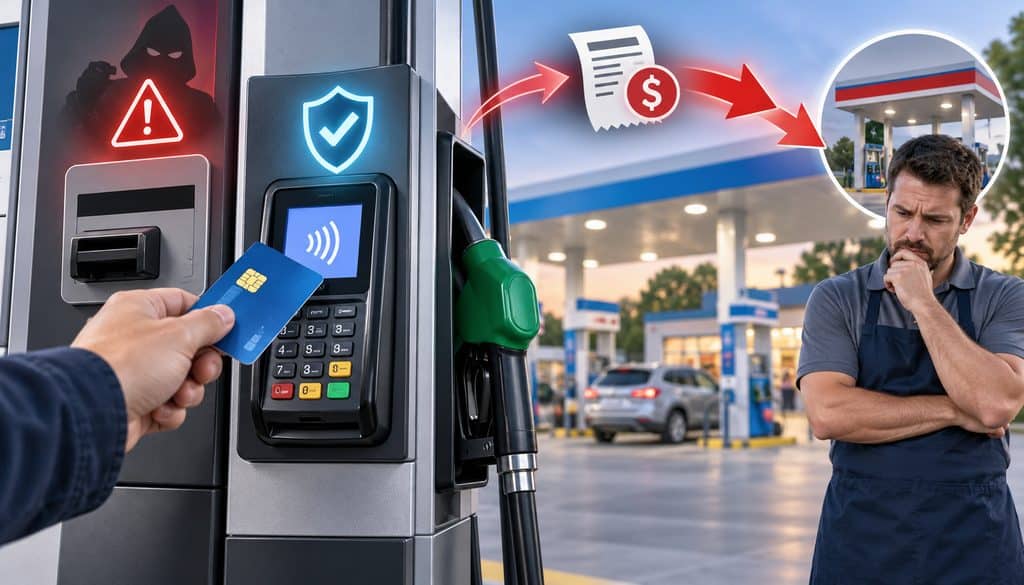
The gas pump EMV liability shift is best understood as a comparison between the security capability of the issued card and the technology actually used to accept it.
If a counterfeit credential represents an account whose legitimate card is chip-enabled, but the fraudulent transaction occurs at a magnetic-stripe-reading-only AFD, the absence of an EMV transaction can become central to liability.
Mastercard’s current merchant chargeback guidance for chip-liability disputes includes U.S. automated fuel dispensers within its chip-liability framework. For a fuel merchant, the important question is whether the transaction satisfies the network’s counterfeit-liability conditions rather than simply whether the processor portal labels the case “fraud.”
This is why AFD EMV chargeback liability should be analyzed from transaction data rather than from the word “fraud” in a processor report.
Liability by acceptance and fraud type
| Scenario | Entry Mode / Pump Capability | Fraud Type | EMV Relevance | Liability Note |
| Chip-capable card account used through counterfeit credential | Magstripe-only AFD | Counterfeit | High | Acquirer/merchant side may bear qualifying liability under the applicable network rule |
| Chip-capable card processed properly | Certified EMV AFD | Counterfeit | High | Liability treatment differs because chip technology was used; protection is not universal for every dispute |
| Genuine lost or stolen card | Any supported mode | Lost/stolen | Different | Must be analyzed under the applicable network fraud rules rather than assumed to be counterfeit |
| Legitimate transaction later denied | Any | Friendly/first-party fraud | Usually not determined merely by EMV | Evidence and applicable dispute rules control |
| Duplicate fuel transaction | Any | Processing error | Low | Batch, clearing and transaction records usually matter more |
| Incorrect amount | Any | Processing error | Low | Pump record, final clearing amount and receipt data may be relevant |
| Online/mobile transaction | Card-not-present or tokenized channel | CNP fraud | Different | AFD counterfeit-liability analysis may not apply |
The operative wording is may bear liability, not “always loses.”
A merchant could receive a fraud dispute that is invalid, miscoded, outside the required conditions, already credited, based on incorrect transaction data or otherwise contestable. That is why experienced dispute teams look at the actual condition and transaction attributes before deciding whether to represent.
Authorization approval is not a fraud-liability guarantee
A common station-level assumption is: “The issuer approved the card, so why can it charge the transaction back later?”
Because authorization and dispute liability answer different questions.
An authorization approval means the authorization request passed the issuer/network decision process at that moment. It does not certify that the person presenting the credential was the legitimate cardholder, nor does it override a later network counterfeit-liability rule.
A cloned credential can therefore produce an approved transaction and still become a valid fraud dispute afterward.
That distinction is especially important with a swipe-only outdoor payment terminal. The merchant’s records can truthfully show an approval code, exact transaction time and gallons dispensed while the network’s liability analysis still turns on the fact that the transaction did not use chip authentication.
The liability analysis starts with understanding how EMV compliance changes fraud exposure at the pump, especially when chip-capable cards are still being accepted through magnetic-stripe-only dispensers. The ROI question is narrower: which losses are actually attributable to that non-EMV acceptance path?
Chargeback Reason Codes for Fuel Merchants
Searching for “chargeback reason codes fuel” can lead operators into one of the easiest dispute-management mistakes: relying on an old chart whose terminology no longer matches the current network or processor portal.
Visa currently organizes fraud disputes by dispute conditions. Its public April 2026 rules identify 10.1 — EMV Liability Shift Counterfeit Fraud, followed by other fraud conditions including non-counterfeit and other card-present fraud categories.
Mastercard’s current merchant chargeback guide uses its own reason/message terminology and expressly includes U.S. AFD transactions within its chip-liability-shift framework.
Processors can then translate those network categories into portal descriptions such as “counterfeit,” “fraud—card present,” “chip liability,” or another internal label.
For a merchant, the best internal mapping therefore has five fields:
processor description → underlying network → network condition/reason → fraud category → EMV relevance
Do not build the process around a static list copied from an old blog post.
The purpose of tracking chargeback reason codes fuel transactions is not administrative neatness. It tells the controller which losses belong in the retrofit analysis and tells the dispute team which cases actually deserve representment.
Dispute triage for an AFD portfolio
| Dispute Type | Counterfeit? | EMV-Related? | Evidence Worth Reviewing | Contestability |
| Chip-liability counterfeit fraud | Usually yes | High | Entry mode, terminal capability, EMV data, network condition | Review, but liability rule may control |
| Other card-present fraud | Not necessarily | Case-specific | Authorization, entry mode, transaction records | Case-specific |
| Lost/stolen-card claim | No, not inherently | Different | Auth and card-entry information | Case-specific |
| Duplicate processing | No | Low | Batch detail, transaction IDs, clearing records | Often evidence-driven |
| Incorrect amount | No | Low | Pump/POS record, receipt, final clearing amount | Often evidence-driven |
| Product/service dispute | No | Low | Transaction and merchant records | Depends on dispute |
| Refund/credit issue | No | Low | Refund records, timestamps, transaction references | Often evidence-driven |
Which counterfeit disputes are hardest to fight at a magstripe pump?
This is where AFD EMV chargeback liability becomes operationally painful.
When all the conditions for a legitimate counterfeit chip-liability dispute are present and the station accepted the transaction at a magnetic-stripe-only pump, ordinary proof that the sale happened may not solve the issue.
- A pump receipt proves the station recorded a sale.
- The timestamp proves when it occurred.
- The gallon quantity proves fuel was dispensed.
- An approval code proves authorization was obtained.
None of those facts necessarily changes the network’s allocation of qualifying counterfeit liability when the central problem is that a chip-capable credential was accepted without chip authentication.
That is why some of these disputes are effectively non-contestable unless the merchant can identify a genuine network-rule defense—for example, incorrect classification, invalid dispute conditions, a prior credit, incorrect transaction information or another recognized basis.
The merchant should not mechanically represent every case merely because records exist.
Representment should be a triage decision
Representment is appropriate when evidence can satisfy a valid network response.
It is not an unlimited appeal mechanism.
For contestable fuel disputes, the evidence package may include:
- transaction log,
- site and pump number,
- terminal/device ID,
- authorization response,
- transaction amount,
- pump receipt,
- entry mode,
- relevant EMV transaction data,
- processor records,
- video evidence where available and lawfully retained,
- credits or reversals already issued,
- and other evidence applicable to that dispute category.
The key question is not “Do we have a receipt?”
It is “Does our evidence actually answer the network condition?”
How Skimming and Counterfeit Fraud Show Up in AFD Disputes
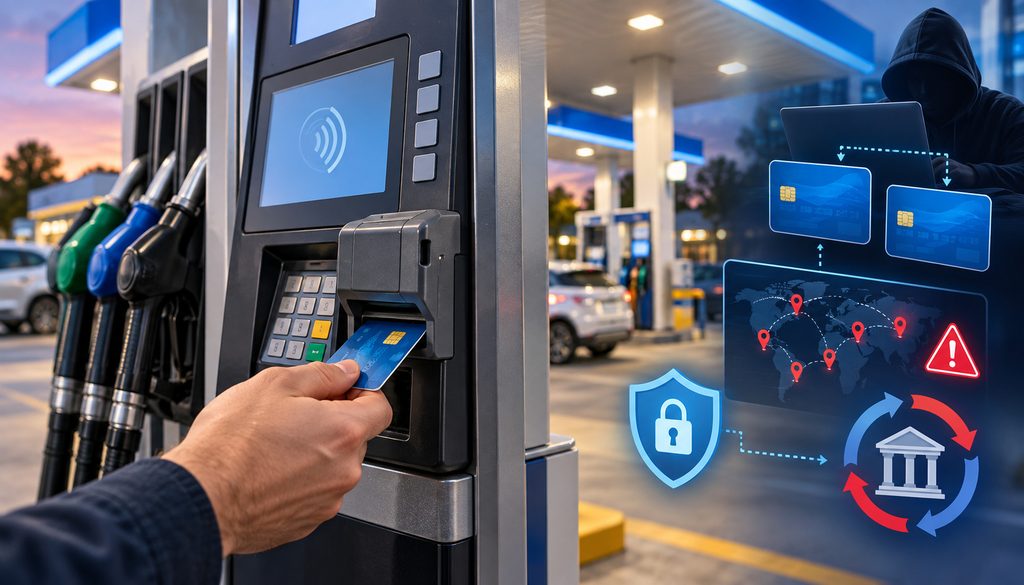
Automated fuel dispenser counterfeit fraud frequently matters because magnetic-stripe account data is static. If payment data is compromised elsewhere—or potentially at a fuel site—it can be misused through counterfeit credentials wherever magnetic-stripe acceptance remains available.
The defensive sequence is straightforward:
account data is compromised → fraudulent credential is used → non-EMV AFD accepts magnetic stripe → issuer/cardholder identifies unauthorized activity → fraud is reported → dispute may follow.
That explanation is intentionally high-level. A fuel retailer does not need instructions about how criminals install or conceal skimming equipment to understand the risk.
AFDs historically attracted attention because they combine unattended use, outdoor equipment, physical access and legacy payment hardware. This is why physical security remains important even after payment modernization.
Chip authentication is only one layer of pump security. Tokenization and encryption in pay-at-the-pump transactions can further limit payment-data exposure, although those controls do not change the liability treatment of a qualifying non-EMV counterfeit transaction.
A fraud cluster is a signal, not proof of pump compromise
A suspected skimming incident may first appear financially rather than physically.
A controller may notice:
- a sudden increase in counterfeit disputes,
- several compromised accounts connected with one site,
- repeated fraud concentrated around a limited timeframe,
- issuer or acquirer warnings,
- higher fraud dollars from a particular terminal group,
- or a law-enforcement or equipment-provider notification.
That does not prove the card data originated at that station.
Cards are used at many locations. Compromise can occur elsewhere, and a fraudulent credential may simply be monetized at the station because its pumps still permit magnetic-stripe acceptance.
The correct response is correlation and investigation, not assumption.
Track the site, terminal ID, transaction time, entry mode, network fraud category and known physical-security events. If multiple signals converge, escalate through the processor, equipment provider and appropriate authorities.
AFD EMV chargeback liability and skimming are related, but not identical
Skimming describes one potential means by which card data is stolen.
AFD EMV chargeback liability describes how qualifying counterfeit losses may be allocated when that stolen data is ultimately used in a transaction.
Those are different layers of the problem.
A station can suffer counterfeit transactions without its own pumps being the compromise point. Conversely, finding evidence of tampering does not tell the accounting department which later disputes qualify under the EMV liability shift.
This distinction prevents fraud investigations from becoming inaccurate chargeback accounting.
Pay-at-the-Pump Fraud Losses: Building a Monthly Loss Model
A reliable analysis of pay at the pump fraud losses begins with the amount actually reversed, not with a generic fraud percentage.
For the first pass:
Monthly counterfeit principal loss = number of qualifying counterfeit chargebacks × average disputed amount
Then track additional costs separately.
Possible categories include:
- chargeback principal,
- processor/acquirer dispute fees actually assessed,
- employee time spent reviewing and responding,
- fraud-related reserves or holds if actually imposed,
- specialized investigation or remediation costs where documented.
Keeping them separate prevents double-counting.
If a $90 transaction is reversed, the $90 principal loss should not be counted again as “lost fuel” in the same ROI equation unless the accounting model is deliberately distinguishing revenue and inventory economics.
Illustrative monthly loss example
Assume a site experiences:
- 20 qualifying counterfeit disputes per month,
- $85 average disputed transaction,
- an illustrative $15 dispute fee per case,
- administrative labor excluded for now.
These figures are hypothetical and are not industry averages.
| Metric | Count / Amount | Monthly Cost | Annualized Cost |
| Counterfeit disputes | 20 | — | 240 disputes |
| Average disputed fuel transaction | $85 | — | — |
| Principal losses | 20 × $85 | $1,700 | $20,400 |
| Illustrative dispute fee | 20 × $15 | $300 | $3,600 |
| Total modeled direct cost | — | $2,000 | $24,000 |
If the processor does not assess a $15 fee, that row becomes zero. If its actual fee is different, use the merchant statement.
More importantly, the $1,700 principal must still be tested for EMV relevance. If five of the 20 cases are actually unrelated fraud categories, those five should not be counted as retrofit-avoidable exposure.
This is why AFD EMV chargeback liability should be reconciled before—not after—the ROI calculation.
Build a chargeback ledger that can feed the ROI model
A practical reconciliation flow is:
processor dispute report → chargeback ledger → network condition → fraud category → site/pump tag → GL loss account → retrofit analysis
Useful ledger fields include:
- dispute date,
- original transaction date,
- site,
- pump or terminal ID,
- network,
- processor description,
- network reason/condition,
- amount,
- entry mode,
- counterfeit yes/no,
- EMV relevance,
- represented yes/no,
- result,
- dispute fee,
- notes.
For searches around chargeback reason codes fuel, this ledger is more useful than a screenshot of a processor dashboard because it creates a repeatable mapping over time.
Site-level analysis is especially useful for multi-location operators
A regional marketer should not assume the highest-volume site automatically has the highest retrofit priority.
Build a site view such as:
| Site | Non-EMV AFD Volume | Counterfeit Disputes | Counterfeit $ | Fraud Rate* | EMV Status |
| Site A | Merchant data | Merchant data | Merchant data | Calculated | Non-EMV |
| Site B | Merchant data | Merchant data | Merchant data | Calculated | Partial |
| Site C | Merchant data | Merchant data | Merchant data | Calculated | EMV |
*Define the denominator explicitly. A dollar-based fraud rate is different from a dispute-count ratio.
A terminal-level version can identify whether losses are concentrated around a particular dispenser. One or two fraud disputes do not prove that device was compromised, but concentration can tell the risk team where to investigate first.
EMV Upgrade ROI for a Gas Station: When the Retrofit Pays for Itself
An EMV upgrade ROI gas station analysis should compare the full installed project cost against the portion of current losses that can reasonably be linked to non-EMV counterfeit exposure.
Do not compare the retrofit cost with total chargebacks.
A useful cost equation is:
Total retrofit cost = hardware + dispenser-specific retrofit components + controller/software upgrades + configuration/certification work + installation labor + other required project costs
If the vendor prices hardware per dispenser, an expanded version is:
Total retrofit cost = per-dispenser installed component cost × number of dispensers + shared controller/POS/software/configuration costs
Cost varies materially by dispenser generation, card reader, PIN pad, payment controller, forecourt software, labor, certification path and whether replacement rather than retrofit is required.
There is no defensible universal “cost per dispenser” for this ROI exercise.
Some operators can upgrade pay-at-the-pump equipment to EMV and contactless without replacing the entire dispenser, but the financial model should still use a current written quote for the exact dispenser, controller, POS, processor, labor, and certification path rather than relying on generic retrofit prices.
The basic break-even equation
For AFD EMV chargeback liability, use:
Break-even months = total installed retrofit cost ÷ monthly avoidable counterfeit loss
“Monthly avoidable counterfeit loss” should include only losses that the merchant reasonably expects to reduce by moving those transactions onto properly certified EMV acceptance.
Do not include:
- friendly fraud,
- card-not-present fraud,
- unrelated refund disputes,
- duplicate processing,
- incorrect-amount cases,
- every lost/stolen-card transaction,
- or miscellaneous chargebacks with no plausible EMV relationship.
Worked break-even example by dispenser
Assume a hypothetical eight-dispenser site receives a complete installed quote of $40,000.
Further assume the station’s dispute analysis shows $4,000 per month of counterfeit losses reasonably attributable to its non-EMV acceptance environment.
The calculation is:
$40,000 ÷ $4,000 = 10 months
In this example, the modeled capital cost equals ten months of current avoidable counterfeit losses.
That is not a prediction that all fraud disappears after month ten. It is a break-even model based on explicitly stated assumptions.
The same AFD EMV chargeback liability economics change sharply at different loss levels.
| Monthly Avoidable Counterfeit Loss | Illustrative Retrofit Cost | Break-Even |
| $1,000 | $40,000 | 40 months |
| $2,000 | $40,000 | 20 months |
| $4,000 | $40,000 | 10 months |
| $8,000 | $40,000 | 5 months |
This sensitivity table is usually more useful than a single ROI percentage because fraud varies over time.
If losses fall to $2,000 monthly, the payback doubles.
If counterfeit attacks concentrate on the location and exposure reaches $8,000 monthly, the calculated payback falls to five months.
That makes the EMV upgrade ROI gas station decision a risk-and-cash-flow question, not merely a technology purchase.
Do not treat every fraud dollar as avoidable
Even a fully certified EMV site can still experience disputes.
Potential residual exposure includes:
- genuine lost/stolen credentials,
- account takeover,
- friendly fraud,
- card-not-present transactions,
- processing errors,
- fallback scenarios,
- other fraud types,
- and transactions on products with different network rules.
EMV materially addresses counterfeit-card risk; it is not a universal chargeback-removal tool.
Fraud losses should also be separated from ordinary payment-processing costs at the pump and inside the store, because interchange, processor markup, network assessments, chargeback principal, and dispute fees are different cost categories and should not be blended into one ROI figure.
Consider secondary benefits without inventing dollar values
A business case may also recognize:
- less counterfeit-dispute workload,
- reduced investigation volume,
- lower risk of fraud escalation,
- potential reduction in acquirer concern,
- modernization of outdoor payment hardware,
- and better support for certified contactless acceptance where included.
Unless the merchant has measured those benefits, do not turn them into fabricated dollars.
The principal ROI model should remain auditable.
Interim Controls While You Wait for an EMV Upgrade
Interim measures can reduce the probability or operational impact of AFD EMV chargeback liability, but they do not convert a magnetic-stripe transaction into an EMV transaction.
A strong pump-inspection routine is valuable.
So are better physical locks where supported, tamper controls, camera coverage, device-level monitoring and rapid incident escalation.
But if a chip-capable card account is ultimately used through a magnetic-stripe-only AFD in a qualifying counterfeit transaction, those controls do not rewrite the network transaction data.
Defensive controls worth reviewing
Fuel retailers waiting for deployment can consider:
- scheduled visual and physical-security inspections,
- documented seal/panel checks where used,
- reader-condition inspection,
- secure forecourt access procedures,
- camera coverage appropriate to the location,
- processor-supported fraud controls,
- AVS/ZIP prompts where supported and appropriate,
- high-level transaction velocity monitoring,
- alerts for unusual card-use or volume patterns,
- rapid review of issuer/acquirer fraud notifications,
- terminal-level dispute analysis,
- taking suspected compromised equipment out of service,
- preserving relevant records,
- and following manufacturer, processor and law-enforcement escalation procedures.
Do not publish predictable fraud-control thresholds externally. A station’s processor and risk team can tune controls without turning the settings into an attacker playbook.
A basic inspection log can be as simple as:
| Date / Time | Pump # | Seal / Panel Check | Reader Condition | Staff Initials | Escalation |
| ___ | ___ | ___ | ___ | ___ | ___ |
Cameras support investigations; they do not perform card authentication
Video may help determine who accessed a dispenser or document an incident.
It may also support certain dispute or law-enforcement investigations.
It does not provide the cryptographic authentication created by a chip transaction and should never be described as a substitute for EMV.
The same applies to frequent inspection. Good pump security lowers exposure probability; it does not erase the underlying gas pump EMV liability shift.
Suspected tampering should trigger operational escalation
If tampering is suspected, the defensible response is high-level:
- remove the affected dispenser from service where appropriate,
- restrict unnecessary access,
- preserve logs and video,
- contact the processor/acquirer,
- contact the equipment provider,
- follow applicable law-enforcement or brand procedures.
Employees should not perform improvised forensic disassembly.
How Excessive Fraud Can Trigger Additional Monitoring
A station absorbing pay at the pump fraud losses also needs to consider what happens outside the individual chargeback.
Networks and acquirers operate merchant-monitoring frameworks. Mastercard currently publishes merchant compliance programs including its Excessive Chargeback Program and Excessive Fraud Merchant Program. Visa likewise maintains fraud-monitoring rules.
The important accounting point is that fraud rate, fraud dollar rate and chargeback ratio are not interchangeable.
A program may evaluate:
- number of fraud transactions,
- fraud dollars,
- fraud as a percentage of sales,
- chargeback counts,
- chargeback ratios,
- duration of elevated activity,
- or another program-specific metric.
Do not take a threshold found in an old article and place it into a 2026 compliance dashboard.
Visa’s previous AFD-specific monitoring program is a good example. The special VFMP-AFD program operated during the delayed transition and was scheduled to conclude after the April 2021 liability shift, with AFD activity returning to the broader monitoring framework.
Historical AFD thresholds from that temporary program should therefore not be presented as today’s universal fuel threshold.
For current AFD EMV chargeback liability management, ask the acquirer what program, if any, applies to the merchant today.
What escalation can mean operationally
Depending on the network, acquirer, severity and merchant agreement, elevated fraud or disputes can lead to:
- formal monitoring,
- remediation requirements,
- additional reporting,
- closer underwriting review,
- increased risk controls,
- reserve or funding-hold decisions by an acquirer,
- requirements to reduce fraud,
- and potentially more serious account consequences if the problem continues.
Not every merchant with elevated fraud will experience every consequence.
Reserve policy, processor action and network-program status should be kept distinct in internal reports.
Maintain a notice file
Save:
- processor fraud alerts,
- acquirer correspondence,
- monitoring notices,
- monthly dispute reports,
- terminal IDs,
- site-level fraud summaries,
- remediation steps,
- equipment-service records,
- and communications documenting corrective action.
This record can show whether fraud improved after a site change and gives the controller better evidence for capital prioritization.
A simple multi-site ranking can look like this:
| Site | Retrofit Cost | Monthly Avoidable Fraud | Break-Even Months | Priority |
| A | $___ | $___ | Cost ÷ loss | ___ |
| B | $___ | $___ | Cost ÷ loss | ___ |
| C | $___ | $___ | Cost ÷ loss | ___ |
High volume alone should not determine the first site upgraded.
A moderate-volume station with a concentrated counterfeit problem may have the best financial payback.
What to Verify Before Accepting an AFD EMV Retrofit Quote
The most expensive mistake in an EMV upgrade ROI gas station calculation is treating “EMV-capable hardware” as a finished payment solution.
It is not enough for a reader to contain a chip slot.
A deployable AFD solution depends on the compatibility and approval of multiple layers.
At minimum, evaluate:
- exact dispenser model,
- reader/PIN pad,
- EMV application/kernel,
- dispenser software,
- forecourt controller,
- petroleum POS,
- processor/acquirer host,
- network implementation,
- provisioning/key-management path,
- installation,
- and end-to-end testing.
A retrofit should be evaluated as part of a complete payment stack rather than as a card-reader purchase. The EMVCo kernel approval process illustrates that EMV functionality is formally tested and approved at the relevant component level; the merchant must still confirm that the complete dispenser, controller, POS, and processor configuration is certified for deployment.
That still does not mean an EMVCo-approved component is automatically certified for every processor, petroleum POS and dispenser combination.
“EMV-capable” and “certified and deployable” are not synonyms
Suppose a station buys new outdoor readers that physically support contact chip.
If its current controller software cannot communicate correctly with that configuration, or the merchant’s processor has not certified that particular implementation, the station may not be able to put certified live EMV transactions through the pumps.
The hardware can be technically capable while the project remains commercially undeployable.
That is why AFD EMV chargeback liability should stay in the financial model until the upgraded transactions are actually processing through the approved EMV path.
Retrofit certification checklist
| Component | Certification / Compatibility Question | Evidence to Request |
| Pump/dispenser | Does the kit support this exact dispenser model/configuration? | Supported-model documentation |
| Reader/PIN pad | Which hardware and firmware versions are included? | Model/firmware specification |
| EMV application/kernel | Which approved implementation/version is used? | Approval/version information |
| Forecourt controller | Is the existing controller supported? | Certified/supported configuration |
| Petroleum POS | Which POS release is required? | Software release requirement |
| Processor/acquirer | Is this exact AFD stack certified on the host? | Written certification/support confirmation |
| Networks | Which card networks are enabled in the certified configuration? | Deployment scope |
| Contactless | Is contactless included and certified? | Supported contactless scope |
| Provisioning | Who performs authorized key/provisioning work? | Installation statement |
| Installation/testing | Who validates live transactions after installation? | Acceptance/test plan |
Contactless deserves its own check.
A quote saying “NFC included” does not automatically establish that certified contactless EMV is available through the exact payment stack being purchased.
If contactless is part of the project, confirm that the proposed hardware and software support the station’s intended contactless and mobile payment setup for fuel transactions. A reader having NFC hardware does not by itself prove that contactless EMV is certified on the merchant’s live processor and forecourt stack.
Tokenized wallet transactions can reduce certain counterfeit exposure, but they should not distract from the core objective: fixing swipe-only chip-card acceptance at the AFD.
Ten questions for the equipment vendor
- Which exact dispenser models does this retrofit support?
- Is the solution certified for our current processor/acquirer?
- Which network applications are included in the certified deployment?
- Does the forecourt controller require new hardware or software?
- Which POS version is required?
- Is certified contactless included or separately priced?
- Are provisioning and authorized key-management services included?
- Is technician installation included?
- What end-to-end transaction testing is performed?
- Who owns troubleshooting if certification or host acceptance fails?
Ten questions for the processor/acquirer
- Which current AFD fraud conditions or reason codes are hitting this merchant?
- Which are true EMV-liability-shift cases?
- Can entry-mode data be supplied for each dispute?
- Can counterfeit loss be reported by terminal ID and site?
- Is the merchant currently in any monitoring program?
- Which current thresholds and remediation requirements apply?
- What fraud-control options are available while upgrades are pending?
- Which AFD EMV platforms are currently certified on the processing host?
- Which dispenser/controller/POS versions are supported?
- Will the processor review the vendor’s proposed configuration before equipment is purchased?
That final question can prevent a costly mismatch.
Common AFD Chargeback and ROI Mistakes
The financial errors surrounding AFD EMV chargeback liability are usually less dramatic than fraud itself, but they can distort a capital decision by tens of thousands of dollars.
| Mistake | Financial / Risk Impact | Better Approach |
| Assuming an approval code prevents fraud liability | Bad disputes are represented and expectations are wrong | Separate authorization from later liability |
| Treating every fraud chargeback identically | ROI is overstated | Categorize counterfeit, lost/stolen, first-party and other fraud |
| Fighting chip-liability cases with receipts alone | Staff time is wasted | Determine whether evidence answers the network condition |
| Using stale reason codes | Cases are misclassified | Map processor terminology to current network conditions |
| Counting every chargeback as EMV-avoidable | Retrofit savings are overstated | Include only reasonably avoidable counterfeit exposure |
| Ignoring dispute fees | Direct cost can be understated | Add actual assessed fees separately |
| Counting the same economic loss twice | ROI is overstated | Define principal, inventory and fees consistently |
| Pricing hardware but excluding implementation | Project cost is understated | Use full installed cost |
| Assuming “EMV ready” means certified | Equipment may not be deployable | Verify end-to-end processor certification |
| Treating inspection as liability protection | Counterfeit exposure remains | Use inspection as mitigation, not an EMV substitute |
| Applying old monitoring thresholds | Compliance decisions are wrong | Use current acquirer/network notices |
| Assuming zero fraud after EMV | Forecast is unrealistic | Measure post-upgrade residual fraud by category |
Practical liability-analysis workflow
A station or multi-site controller can turn the article into an operating process:
- Pull 6–12 months of AFD disputes.
- Separate fraud from non-fraud disputes.
- Identify counterfeit-fraud cases.
- Match them with pump/terminal transaction data.
- Determine which transactions came through non-EMV AFDs.
- Map processor labels to current network reason/condition terminology.
- Confirm which losses appear driven by the chip liability shift.
- Calculate chargeback principal.
- Track dispute fees separately.
- Tag losses by location.
- Tag by terminal/device ID where data permits.
- Calculate average monthly avoidable counterfeit exposure.
- Obtain a full retrofit quote.
- Verify exact equipment compatibility.
- Verify processor/acquirer certification.
- Add software, controller, installation and configuration costs.
- Calculate break-even months.
- Rank sites by financial payback and risk.
- Apply interim pump-security measures.
- Upgrade and test.
- Monitor fallback.
- Compare post-upgrade counterfeit losses.
- Update the ROI model using actual results.
Measure the before-and-after result
After deployment, compare consistent periods using:
- counterfeit dispute count,
- counterfeit dispute dollars,
- counterfeit fraud rate,
- total fraud,
- total chargebacks,
- fallback transactions,
- and fraud-related operational workload.
Do not judge the project only by total chargebacks.
If counterfeit fraud falls while billing-error disputes remain unchanged, the EMV investment may be performing exactly as expected.
Watch unexplained fallback after upgrading
An EMV-capable terminal can still produce legitimate fallback in certain circumstances.
Fallback should nevertheless be monitored.
A site showing persistent or unexplained fallback deserves investigation because it can weaken the benefits expected from chip acceptance.
Do not publish the merchant’s fraud-control trigger thresholds or diagnostic rules publicly.
Fleet and proprietary cards also deserve caution. Their acceptance, authorization and liability arrangements can differ from general-purpose consumer-card rules.
Likewise, PIN-debit routing and economics should not be treated as identical to general-purpose credit-card counterfeit rules merely because both transactions occur at the same pump.
Non-EMV AFD Liability and Upgrade Checklist
Use this checklist to turn the gas pump EMV liability shift from a general risk concept into a measured capital decision.
- Identify every dispenser still operating without certified EMV acceptance.
- Pull 6–12 months of pump card volume.
- Pull matching fraud and chargeback reports.
- Separate counterfeit fraud from other disputes.
- Confirm current network dispute reason/condition terminology.
- Identify chip-capable-card transactions where the available data permits.
- Tag disputes by site.
- Tag disputes by pump or terminal ID where supported.
- Calculate counterfeit principal losses.
- Track dispute fees separately.
- Exclude unrelated chargebacks from the retrofit model.
- Calculate average monthly avoidable counterfeit exposure.
- Annualize that exposure.
- Review processor/acquirer monitoring notices.
- Confirm whether reserves or holds are actually being applied before counting them as cost.
- Review interim pump-inspection procedures.
- Document suspected tampering escalation.
- Obtain a complete retrofit quote.
- Confirm exact dispenser-model compatibility.
- Confirm reader/PIN-pad hardware and firmware.
- Confirm EMV application/kernel scope.
- Confirm forecourt-controller compatibility.
- Confirm petroleum POS compatibility.
- Confirm processor/acquirer certification.
- Confirm supported networks.
- Confirm installation and configuration cost.
- Confirm provisioning responsibility.
- Confirm certified contactless scope if included.
- Calculate full installed cost.
- Calculate break-even months.
- Run lower- and higher-fraud sensitivity cases.
- Rank multi-site projects by avoidable counterfeit loss and payback.
- Schedule the upgrade.
- Test live certified EMV transactions.
- Monitor fallback volume.
- Compare post-upgrade counterfeit dispute counts and dollars.
- Update actual pay at the pump fraud losses in the ROI model.
Frequently Asked Questions
What is AFD EMV chargeback liability?
AFD EMV chargeback liability refers to how qualifying fraud losses can be allocated when an automated fuel dispenser transaction involves chip technology that was available on the card side but was not used by the acceptance side.
It is particularly important for qualifying counterfeit-card fraud at magnetic-stripe-only pumps. It does not mean a station automatically loses every fraud dispute.
What changed in the April 2021 gas pump EMV liability shift?
The final U.S. AFD dates varied slightly by network. Mastercard’s shift for U.S. AFD transactions took effect April 16, 2021, while Visa’s U.S. domestic AFD shift took effect April 17, 2021.
The practical change was that fuel merchants remaining on less-secure acceptance technology could face qualifying counterfeit losses that previously fell differently within the payment ecosystem.
Does a gas station automatically lose every fraud chargeback at a non-EMV pump?
No.
The dispute must be analyzed according to its network, fraud category, transaction details and applicable rules. Counterfeit chip-liability cases are different from lost/stolen fraud, first-party fraud, duplicate transactions, authorization disputes or service-related disputes.
Which counterfeit-fraud disputes are hardest to fight at a magstripe dispenser?
Qualifying counterfeit disputes in which a chip-capable card account was used through a non-EMV magnetic-stripe acceptance path can be especially difficult because the liability issue concerns the authentication technology. A normal receipt may prove fuel was dispensed without changing that liability allocation.
Does an authorization approval protect a station from later counterfeit fraud?
No.
Authorization determines whether the issuer approves the transaction at that moment. A later fraud dispute can still be valid, and the applicable chip-liability rule can still determine which side absorbs the loss.
What chargeback reason codes commonly affect fuel merchants?
There is no single timeless list of chargeback reason codes fuel operators should copy into a spreadsheet.
Visa currently uses dispute conditions including 10.1 for EMV Liability Shift Counterfeit Fraud. Mastercard uses its own current message/reason framework. Processor dashboards may translate both into different merchant-facing labels.
Maintain a mapping from processor description to the underlying network condition.
How does skimming show up in pay-at-the-pump fraud disputes?
Possible indicators include concentrated counterfeit cases, several compromised accounts associated with a location or timeframe, unusual fraud increases and issuer/acquirer notifications.
Those signals justify investigation but do not establish that the merchant’s dispenser was necessarily the place where card data was stolen.
Can a receipt defeat a counterfeit-fraud chargeback?
Not necessarily.
A receipt documents the transaction. If the dispute is governed by a valid counterfeit chip-liability rule, proof that the transaction occurred may not address the actual reason for liability. Review the network condition before deciding to represent.
How do I calculate monthly pay-at-the-pump fraud losses?
Start with:
qualifying counterfeit dispute count × average disputed amount
Then separately add actual dispute fees and measurable administrative expense if you want a broader operating-cost model.
Do not include unrelated dispute categories simply because they occurred at a fuel station.
How do I calculate EMV upgrade ROI for a gas station?
For an EMV upgrade ROI gas station calculation:
Break-even months = full installed retrofit cost ÷ average monthly avoidable counterfeit loss
Use installed and certified project cost, not hardware price alone. Run several loss scenarios because fraud levels can fluctuate significantly.
What fraud should I exclude from EMV ROI calculations?
Exclude losses that the retrofit is not reasonably expected to prevent or change, including unrelated processing errors, ordinary friendly fraud, unrelated card-not-present fraud and other dispute categories without a meaningful EMV connection. The objective is to model avoided counterfeit exposure, not all fraud experienced by the merchant.
What can I do while waiting for an EMV retrofit?
Use defensive controls such as frequent pump inspection, documented tamper checks, appropriate camera coverage, secure forecourt access, processor-supported fraud controls, transaction monitoring and rapid response to alerts.
These measures can reduce automated fuel dispenser counterfeit fraud exposure, but they do not convert a swipe transaction into a chip transaction.
Can high fraud rates put a fuel merchant into a monitoring program?
Yes, elevated fraud or chargebacks can attract network or acquirer scrutiny.
Do not rely on old static internet thresholds. Program definitions and criteria can change, and the former Visa AFD-specific monitoring program was transitional. Ask the acquirer which current programs, measures and remediation requirements apply to the specific merchant.
What does “EMV-certified” mean on a retrofit quote?
It should mean more than the reader being physically capable of accepting a chip.
The deployment must work through the required dispenser, payment device, EMV application, controller, POS and processor/acquirer stack, with the relevant network implementation tested and supported. Ask the vendor and processor for the exact certified configuration.
How do I know whether a retrofit is certified for my processor and pump model?
Give the vendor the exact dispenser model, payment device, controller, POS version and processor/acquirer. Then ask for written confirmation that the proposed configuration is supported and certified for that stack. Have the processor verify the proposal before equipment is purchased.
“EMV ready” or “chip capable” should not be treated as sufficient evidence.
Conclusion
The April 2021 AFD liability shifts changed the economics of continuing to accept chip-capable card accounts through magnetic-stripe-only pumps. For qualifying counterfeit transactions, remaining on the less-secure acceptance path can leave the acquirer and merchant side absorbing losses that could have been allocated differently with properly deployed EMV.
That does not make every fuel dispute an EMV loss. Counterfeit fraud must be separated from lost/stolen-card activity, first-party fraud, processing errors, card-not-present fraud and other dispute categories before a station calculates its exposure.
The most useful decision metric is therefore not total chargebacks. It is monthly counterfeit loss reasonably attributable to non-EMV acceptance compared with the full installed cost of a certified retrofit.
Inspections, tamper controls, monitoring and fraud rules can reduce risk while an upgrade is pending, but they do not replace chip authentication. Sustained fraud can also create broader acquirer or network concerns beyond the individual transactions.
Finally, treat certification as part of the purchase itself. A reader that accepts a chip physically is not enough. The dispenser, payment device, controller, POS software and processor/acquirer path must work together in an approved, deployable configuration.